MonkeyBoutique is a free clothing planning guide. Start with an occasion you regularly dress for: commuting, working from home, or meeting friends. Write down the outfit you already use. Identify the missing piece before you browse. A jacket that works with your usual trousers gives you a clearer purchase brief than a general search for something new.
Put a spending limit beside that brief. Include delivery, tax, and any alteration quote in the amount you expect to pay. Leave the purchase until later if it does not fit that limit. A small projected cost per wear does not make an unaffordable checkout affordable.
Try your own numbers
Clothing cost-per-wear calculator
Compare two garments over the same period. Enter costs in US dollars. The starting values are examples, not prices or durability claims.
Enter your estimates to compare garments.
Use a whole number of wears above zero. Enter total care spending for your chosen period, not the cost of one wash. Blank or invalid fields pause the comparison.
Cost per wear = (purchase + alterations and repairs + care) ÷ expected wears.
Method: Montana State University Extension, Buymanship Project, accessed 2026, divides garment and maintenance costs by wears. This calculator separates alterations for clarity. It uses your estimates without fetching prices or sending your inputs.
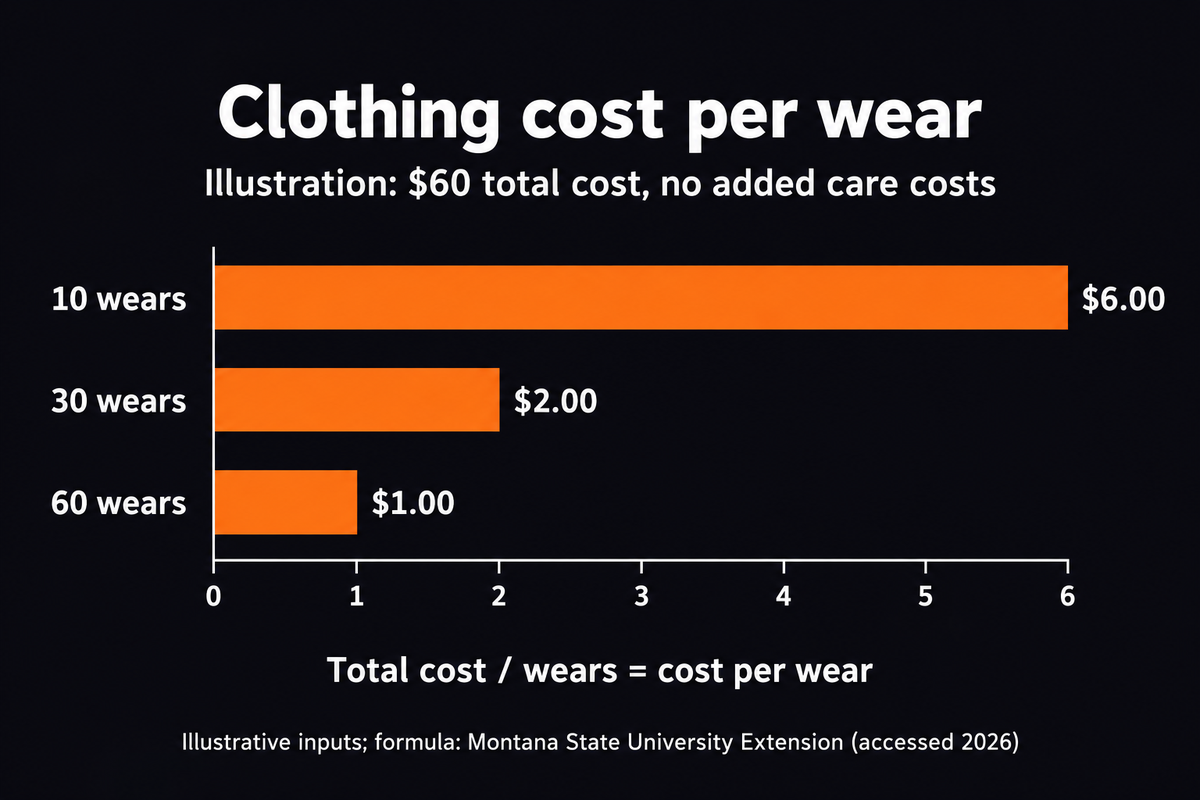
Illustration: $60 total cost divided by 10, 30, or 60 wears gives $6, $2, or $1 per wear. Formula: Montana State University Extension, accessed 2026.
Read the result without justifying extra spending
The comparison divides spending by use. It does not score comfort, fabric strength, or environmental impact. Enter a cautious wear estimate, then reduce it and compare again. If a garment only looks worthwhile under an optimistic estimate, reconsider how often it fits your actual week.
Keep the period consistent. Do not compare a summer of use for one garment against several years for another. Include cleaning and repairs for that same period. Leave resale income out of this calculation because a future sale price is uncertain. For an item you own, enter the amount you paid if you want its overall cost per wear.
Check the garment before you buy
Try it with your clothes
Bring the shoes or layers you expect to wear with it. Sit, reach, and walk during the fitting. Check whether seams pull or openings gape. These movement checks follow Montana State University Extension’s Buymanship Project guidance, accessed 2026.
Read the care instructions
The US Federal Trade Commission’s Care Labeling Rule guidance, accessed 2026, explains that covered garments need regular care instructions. Check the label before you decide. Ask for a cleaning quote when the required care is unfamiliar, then include that estimate in the calculator.
Inspect a secondhand option
Check the fastening, lining, seams, and areas that rub during use. Ask about marks or repairs that photographs do not show. Include an alteration quote before comparing it with a new option. Treat an unknown repair cost as an unanswered question, rather than entering zero.
Keep a simple wardrobe record
After a purchase, note when you wear the garment and what you spend on care. Replace your estimate with that record when you next compare purchases. You can also use the record to identify clothes you reach for repeatedly. Let those observations guide your next shopping brief.
Choose colours, shapes, and layers that you enjoy wearing together. There is no required wardrobe size in this guide. The useful question is whether the next garment fills a real gap.
Sources checked 28 October 2026: Montana State University Extension, Buymanship Project; US Federal Trade Commission, Clothes Captioning: Complying with the Care Labeling Rule. Example amounts illustrate arithmetic; they are not market averages.